WILAYAH NEWS VOICE OF THE GLOBAL AWAKENING


Related Articles



**Al‑Mubāhala and the Content of the Letter**
Najran, with its seventy surrounding villages, lies on the border between the regions of Hijaz and Yemen. At the beginning of the rise of Islam, this area was the only region in the Hijaz whose people had abandoned paganism for specific reasons and embraced Christianity.
The Messenger of Islam wrote a letter to the Bishop of Najran, **Abu Ḥāritha**, inviting its people to Islam at the same time that he sent letters to the kings and leaders of the world.
The content of the letter was as follows:
“In the name of the God of Abraham, Isaac, and Jacob. From Muhammad, the Messenger of God, to the Bishop of Najran and the people of Najran: If you accept Islam, I praise to you God, the God of Abraham, Isaac, and Jacob. Now then: I call you to the worship of God instead of the worship of servants, and I call you to the authority of God instead of the authority of servants. If you refuse, then the jizya (tribute). If you refuse that as well, then I have declared war upon you. Peace.”
Some Shi‘i historical sources add that the Prophet also wrote in that letter the Qur’anic verse addressed to the People of the Book:
“Say: O People of the Book, come to a word that is common between us and you: that we worship none but God and associate nothing with Him.”
(Qur’an 3:64)
This verse calls them to worship the One Almighty God.
The envoy of the Messenger of God delivered the letter to the Bishop of Najran. The bishop read it very carefully, then formed a council to deliberate and make a decision. The group included prominent religious and non‑religious figures. One of its members was **Shurahbil**, known for his intelligence, nobility, wisdom, and good judgment. When the bishop consulted him, he said:
“You know what God promised Abraham regarding prophethood among the descendants of Ishmael. How can you be certain that this man is not that prophet? I have no authority to judge about prophethood. If it were a worldly matter, I would advise you and do my utmost for you.”
The council decided to send a delegation to Medina to discuss matters with the Prophet and examine the signs of his prophethood. Sixty of the most knowledgeable and respected people of Najran were chosen. At their head were three bishops:
1. **Abu Ḥāritha ibn ‘Alqama** – the grand bishop of Najran and the official representative of the Byzantine churches in the Hijaz.
2. **‘Abd al‑Masīḥ** – the leader of the Najran delegation, known for intelligence and political skill.
3. **Al‑Aiham** – an elderly and highly respected figure among the people of Najran.
The Christian delegation arrived in Medina and entered the mosque wearing their church garments—silk and brocade—wearing gold rings and carrying crosses around their necks. Their appearance, especially inside the mosque, disturbed the Messenger of God. They noticed his discomfort but did not know the reason.
They asked **‘Uthman ibn ‘Affan** and **‘Abd al‑Raḥmān ibn ‘Awf**, with whom they had previous friendship. These two asked **‘Ali ibn Abi Talib** what should be done. ‘Ali said:
“I think they should remove their garments and rings, then return to him.”
They did so, then returned to the Prophet, greeted him, and he greeted them in return with respect. He accepted some of the gifts they brought.
Before beginning their discussions, the delegation said that the time for their prayer had arrived and asked permission to perform it. Some Muslims wanted to prevent them, but the Prophet said:
“Let them be.”
They faced the east and performed their prayer.
Thus, the Prophet gave a lesson in religious tolerance that refutes accusations made by the enemies of Islam.
**The Negotiations between the Delegation of Najran and the Prophet**
Several biographers and Islamic scholars recorded the dialogue that took place between the Christian delegation and the Prophet. A portion of that dialogue, reported by al‑Halabi in his biography, is as follows:
The Prophet invited them to Islam and recited the Qur’an to them. They refused and said, “We were Muslims before you.”
The Prophet replied: “You are lying. Three things prevent you from Islam: your worship of the cross, your eating pork, and your claim that God has a son.”
They said: “Christ is God because he raised the dead, informed about unseen matters, healed diseases, and created a bird from clay.”
The Prophet replied: “He is the servant of God and His word that He cast to Mary.”
One of them said: “Christ is the son of God because he has no father.”
The Prophet remained silent, then revelation came with the verse:
“Indeed, the likeness of Jesus in the sight of God is like that of Adam. He created him from dust.”
(Qur’an 3:59)
The delegation said: “We only grow further apart from you regarding our companion. This is something we cannot accept. Let us invoke mutual imprecation (mubāhala) so that God’s curse may fall upon the liars.”
Then God revealed the verse of **Mubāhala**:
“If anyone disputes with you concerning him after the knowledge that has come to you, say: Come, let us call our sons and your sons, our women and your women, ourselves and yourselves, then let us pray earnestly and invoke the curse of God upon the liars.”
(Qur’an 3:61)
The Prophet invited them to the Mubāhala, and they accepted. Both sides agreed to meet the following day.
**The Prophet’s Departure for the Mubāhala**
The event of the Prophet’s Mubāhala with the delegation of Najran is one of the most remarkable events in Islamic history. Although some commentators and historians summarized it briefly, many scholars—such as al‑Zamakhshari in *Al‑Kashshaf*, Fakhr al‑Razi in his *Tafsir*, and Ibn al‑Athir in *Al‑Kamil*—discussed it extensively.
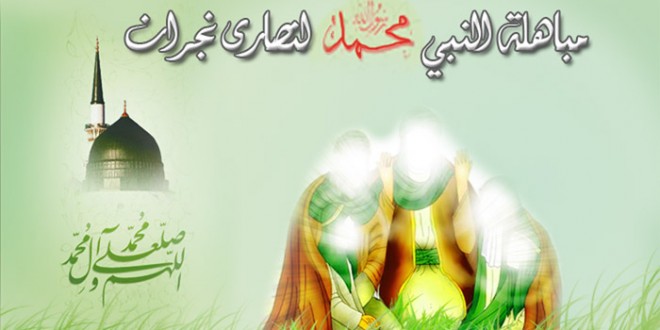
When the appointed time arrived, the Prophet selected only four people from among the Muslims and his family to accompany him:
– **Ali ibn Abi Talib**
– **Fatima al‑Zahra**, the daughter of the Prophet
– **Hasan**
– **Husayn**
No one among the Muslims was purer in soul or deeper in faith than them.
The Prophet left his house carrying Husayn, holding Hasan by the hand. Fatima walked behind him and Ali behind her. He said to them: “When I supplicate, say ‘Amen.’”
Meanwhile, the leaders of the Najran delegation had told one another:
“Observe Muhammad tomorrow. If he comes with his family and children, beware of engaging in the Mubāhala. But if he comes with his companions, then proceed, for he would not truly be confident.”
They reasoned that if he came with his closest family members rather than with worldly power or military display, it would indicate deep certainty in his truth.
When they saw the Prophet approaching with these four radiant figures, they were astonished that he had brought his most beloved family members to such a serious event. They realized how confident he must be in his message.
The Bishop of Najran then said:
“O Christians, I see faces that, if they were to ask God to move a mountain from its place, He would do so. Do not enter into Mubāhala with them, or you will perish, and no Christian will remain on earth until the Day of Resurrection.”
**The Withdrawal of the Delegation of Najran**
After hearing this, the delegation consulted one another and decided not to proceed with the Mubāhala. Instead, they agreed to pay the **jizya** annually, while the Islamic state would guarantee their protection.
The Prophet accepted this arrangement and granted the Christians of Najran certain rights under the Islamic government in exchange for a modest annual payment.
The Prophet then said:
“By the One in whose hand is my soul, punishment had nearly descended upon the people of Najran. If they had engaged in Mubāhala with me, they would have been transformed into monkeys and pigs, fire would have consumed the valley, and God would have destroyed Najran and its people.”
A narration from **Aisha** states that on the day of Mubāhala the Prophet came out wearing a black cloak. Hasan came and he brought him under it, then Husayn, then Fatima, then Ali. Then he recited:
“Indeed, God only desires to remove impurity from you, O People of the House, and to purify you completely.”
(Qur’an 33:33)
Al‑Zamakhshari concludes that this event is a powerful proof of the virtue of the People of the Cloak and a clear sign of the truth of the Prophet’s mission, since neither supporters nor opponents reported that the Christians agreed to carry out the Mubāhala.
**The Text of the Prophetic Treaty with the People of Najran**
The delegation requested that the Prophet write down the agreed amount of jizya and guarantee their security. By the Prophet’s order, **Ali ibn Abi Talib** wrote the document, which included the following terms:
“In the name of God, the Most Merciful, the Most Compassionate. This is what Muhammad, the Messenger of God, has written for Najran and its surrounding areas… They are granted the protection of God and the covenant of Muhammad the Prophet concerning their lives, religion, land, wealth, churches, and monastic life. They shall not be compelled to pay tithes, nor consume or practice usury. Whoever among them practices usury after this will have no protection under my covenant…”
**A Great Virtue**
The event of Mubāhala and the Qur’anic verse revealed about it are considered by Shi‘a scholars to be among the greatest evidences supporting the special status of the Prophet’s family.
The verse refers to **Hasan and Husayn as the “sons” of the Prophet**, **Fatima as the sole representative of “our women,”** and **Ali as “ourselves.”** Thus, according to this interpretation, Ali is described as being like the very self of the Prophet in spiritual rank.
Shi‘a scholars argue that this verse demonstrates the exceptional status of Ali and the Ahl al‑Bayt among all Muslims.
According to narrations from the Imams of the Ahl al‑Bayt, the practice of Mubāhala is not limited to the Prophet; it may also be used by Muslims in religious disputes with opponents. The method and specific supplications for Mubāhala are recorded in hadith books, including **“Nur al‑Thaqalayn.”**