 WILAYAH NEWS VOICE OF THE GLOBAL AWAKENING


Related Articles



His Name and Birth
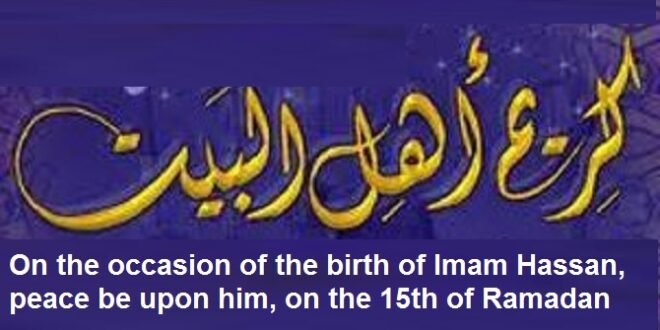
Imam Hassan bin Ali bin Abi Talib (peace be upon him) was born on the 15th of Ramadan in the third year of Hijra [1], although some say it was the second year [2], in Medina. His mother was Fatimah al-Zahra (peace be upon her), the Lady of the Women of the Worlds, and daughter of the Prophet Muhammad (peace be upon him and his family).
Upon hearing the news of his blessed birth, the Prophet (peace be upon him and his family) quickly went to Ali’s house and called for Asma to bring him his son. He then performed the Adhan (call to prayer) in his right ear and the Iqama in his left ear, and named him Hassan by the command of Jibril (Gabriel) (peace be upon him). On the seventh day, the Prophet (PBUH) sacrificed a ram on his behalf, shaved his head, and gave the weight of his hair in silver as charity [3].
[1] Al-Irshad 2:5, Dalail al-Imama: 60.
[2] Al-Kafi 1:461.
[3] Bihar al-Anwar 43:239, 257.
His Kunya and Titles
Imam Hassan’s kunya (nickname) was Abu Muhammad, and he had many titles, the most famous being: Al-Taqi, Al-Tayyib, Al-Zaki, Al-Sayyid, Al-Sibt, Al-Wali, Al-Hujjah, Al-Mujtaba, and Al-Zahid [1].
[1] Bihar al-Anwar 43:255.
His Appearance
Imam Hassan resembled the Prophet (PBUH) in both appearance and character. He was described as having a fair complexion with a reddish tint, with large, dark eyes. His face was smooth, without prominent cheekbones, and his hair extended from his chest to his navel. His beard was thick, and his hair reached the earlobes. His shoulders were broad, and he had a medium height, neither too tall nor too short. He was known to dye his hair black and was of an excellent physical appearance [3].
Moreover, Imam Hassan was also described as resembling the Prophet (PBUH) in his demeanor and leadership qualities. According to a narration, when Fatimah brought her sons Hassan and Hussain to the Prophet during his last illness, the Prophet (PBUH) said: “As for Hassan, he has my guidance and leadership, and as for Hussain, he has my generosity and bravery.” Another narration mentions that Hassan resembled the Prophet (PBUH) in his dignity and leadership [4].
His Upbringing
Imam Hassan (PBUH) was raised in the household of the Prophet Muhammad (PBUH), under the care of his grandfather. The Prophet (PBUH) referred to him as his son and frequently made it clear to the Muslims that Hassan and Hussain were his sons. He even mentioned in the verse of Mubahila: “Say: Come, let us call our sons and your sons…” [1].
The Prophet (PBUH) also played with Hassan as a child. It was reported that he would stick out his tongue for Hassan to play with, and when Hassan smiled, the Prophet (PBUH) would laugh joyfully.
Imam Hassan (PBUH) grew up under the care and love of both his grandfather, the Prophet (PBUH), and his father, Amir al-Mu’minin Ali (PBUH), who introduced him as the son of the Prophet to the Muslim community.
His Status
The Prophet (PBUH) made it clear on several occasions, in front of the Muslim community, the high status of Imam Hassan and his brother Imam Hussain (PBUH). He famously said: “Whoever wants to see the leader of the youth of Paradise should look at Hassan bin Ali.” The Prophet (PBUH) also referred to them as the masters of the youth of Paradise. On one occasion, when the Prophet (PBUH) was carrying Hassan and Hussain on his shoulders, a man said: “You love them!” The Prophet (PBUH) responded: “Whoever loves them, loves me, and whoever hates them, hates me” [3].
His Leadership
Imam Hassan and his brother Hussain (PBUH) played a pivotal role in Islamic history, particularly in the preservation and defense of the faith. Imam Hassan’s leadership was recognized by all, and his actions affirmed his position as a rightful Imam, as indicated by the consensus of the family of the Prophet (PBUH).
The Prophet (PBUH) had declared: “These two sons of mine, Hassan and Hussain, are Imams, whether they rise up in battle or remain seated.” This statement affirmed their leadership, regardless of their active role or peaceful approach. Their actions during their lifetimes, particularly during the conflicts in which they were involved, demonstrated their true role as Imams of the Muslim Ummah.
The Quranic Verses Revealed about Imam Hassan (PBUH)
Several Quranic verses were revealed in praise of Imam Hassan (PBUH) and his family. Some of the most famous verses include:
-
Ayat al-Tathir (Purification)
“Indeed, Allah only intends to remove the impurity from you, O People of the Household, and to purify you with a thorough purification.” (Quran 33:33).
This verse was revealed about the Prophet (PBUH), Ali (PBUH), Fatimah (PBUH), Hassan (PBUH), and Hussain (PBUH) in the house of Umm Salama [2]. -
Ayat al-Insan (The Man)
“And they give food in spite of their love for it to the needy, the orphan, and the captive.” (Quran 76:8).
This verse was revealed in relation to the family of Ali (PBUH) and Fatimah (PBUH), who gave charity despite their own hunger [4]. -
Ayat al-Mubahala (The Curse)
“Say: Come, let us call our sons and your sons, our women and your women, and ourselves and yourselves…” (Quran 3:61).
This verse refers to the event of Mubahala, where the Prophet (PBUH) called upon Hassan and Hussain (PBUH) to represent the family of the Prophet in a confrontation with the Christians [6].
These verses reflect the high status and purity of Imam Hassan (PBUH) and his family, which is affirmed by the Islamic tradition and Quranic revelation.
Conclusion
Imam Hassan al-Mujtaba (PBUH) stands as a central figure in Islamic history, revered for his leadership, wisdom, and his deep connection to the Prophet Muhammad (PBUH). His life is a model of piety, sacrifice, and upholding the values of Islam, particularly through his patience and his commitment to peace during a time of significant political turmoil.