## Tehran–Washington Memorandum of Understanding: Why Are Experts Skeptical?
8 seconds ago
News and analysis أخبار وتحاليل
0 Views
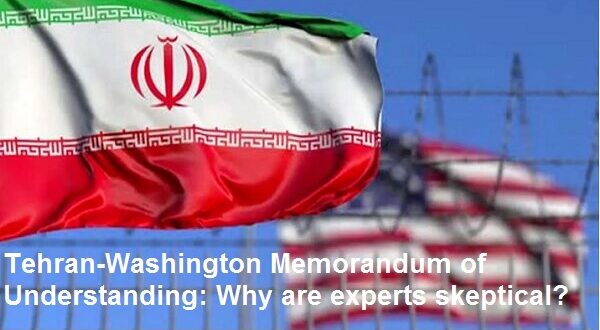
## Tehran–Washington Memorandum of Understanding: Why Are Experts Skeptical?
**Al‑Waqt** – These days, U.S. President Donald Trump is issuing threats while claiming that an agreement or understanding exists with Iran. Such threats once again demonstrate, critics say, the unreliability of any understanding or agreement with the United States. Iranian journalist Mohammad Imani argues that the term “memorandum of understanding” in relations between Tehran and Washington is merely a pretext, asserting that “an understanding with the devil has no meaning.” From a legal perspective, he adds, an agreement that contains binding implementation obligations for the parties is called a “contract” or “agreement,” not a “memorandum of understanding.”
Nevertheless, many believe that the Trump administration will not adhere to the commitments contained in a memorandum of understanding with Iran, and that there is little reason for optimism that even a jointly signed, lengthy message by the presidents of the United States and Iran would not ultimately be met with broken promises and instability from Washington.
Many experts have described Trump as lacking credibility, being unpredictable, adopting an interest‑based approach, and offering few guarantees in agreements. But what is the real reason behind this skepticism toward Trump? And why do some believe his claims about a memorandum of understanding with Iran cannot be trusted?
### Trump’s Troubled Record
One of the main reasons for pessimism about any agreement or understanding with a Trump administration is his record of withdrawing from the Joint Comprehensive Plan of Action (the nuclear deal) during his first term. After Trump withdrew from the agreement, Susan Maloney, deputy director at the Brookings Institution, wrote that the decision “effectively undermined America’s commitment to the deal,” leading to its collapse and rising tensions. According to her, this history has reduced Iran’s confidence in U.S. commitments in any future agreement.
In fact, the central problem lies in Iran’s lack of trust in the United States, a distrust that was intensified by Trump’s withdrawal from the nuclear deal. Sanam Vakil, director of the Middle East and North Africa Programme at Chatham House in London, has repeatedly emphasized that the U.S. withdrawal from the nuclear deal in 2018 created a deep trust gap, and that this “lack of trust” is the biggest obstacle to any new agreement. She believes that any deal lacking strong verification mechanisms and enforcement guarantees will be fragile.
### Self‑Interest and a Transactional Approach
Another major problem in reaching an agreement with Trump is his speculative and utilitarian approach to diplomacy in international relations. In a 2026 analysis, Laurel Rapp wrote that Trump would support an agreement when he can present it as a political success for himself. However, if he feels the agreement does not sufficiently serve his interests, he may change his position or demand its revision.
Many foreign policy researchers, including analysts at the *Financial Times*, believe Trump’s approach represents a “transactional foreign policy,” meaning his decisions are based more on immediate calculations of political and economic gains and losses than on long‑term commitments. This characteristic makes others doubt the durability of agreements reached with him.
Megan McArdle, a columnist for *The Washington Post*, wrote in an article titled “The Best Explanation for Trump’s Presidency: He Acts Like a Real Estate Developer”:
“To understand Trump’s behavior, we must view him not as a politician but as a property developer and real‑estate dealer.” She argues that Trump approaches foreign policy much like the real‑estate market—seeing each issue as a separate deal and caring more about “winning the deal” than about honoring commitments or implementing a long‑term strategy.
### Political Instability in Washington
Political instability in the United States is also considered one of the major obstacles to any agreement with Washington, as a change in government can easily alter U.S. commitments. Robert Einhorn, a veteran American diplomat and a fellow at the Brookings Institution, believes that one of the fundamental problems with any new agreement with the White House is the possibility that the next U.S. president could withdraw from it—just as Trump did in 2018. Therefore, sustaining an agreement requires mechanisms that go beyond the will of a single president.
In assessing the Trump administration’s Iran policy, Richard Haass, former president of the Council on Foreign Relations, pointed out that the Joint Comprehensive Plan of Action had limited Iran’s nuclear program and established a comprehensive inspection regime. The U.S. withdrawal from it, he said, demonstrated that even with extensive inspection mechanisms in place, a change in the American administration can cancel and undermine any agreement reached by the previous one.
In reality, many analysts believe that U.S. foreign policy has increasingly become tied to the outcomes of presidential elections. For example, the Obama administration signed the nuclear deal, the Trump administration withdrew from it, and the Joe Biden administration attempted to resume negotiations to revive it. Such fluctuations have led many countries to question the reliability of any agreement with the United States.
 WILAYAH NEWS VOICE OF THE GLOBAL AWAKENING