WILAYAH NEWS VOICE OF THE GLOBAL AWAKENING


Related Articles
### In the Name of Allah, the Most Gracious, the Most Merciful
All praise is due to Allah, the Lord of the worlds.
Peace and blessings be upon the most noble of the messengers, Muhammad—may the prayers of Allah be upon him and his family.
The light of guidance,
The leader toward goodness,
The caller to righteousness,
The Prophet of mercy,
The Imam of the God‑fearing,
And the Messenger of the Lord of the worlds.
…
Peace be upon Husayn,
And upon Ali ibn Husayn,
And upon the sons of Husayn,
And upon the companions of Husayn.
…
In the noble supplication *Du‘a al‑Nudbah* we read these luminous passages addressing Imam al‑Mahdi (peace be upon him):
“Where is the Master of the Day of Victory and the one who will spread the banner of guidance?
Where is the one who will unite the people upon righteousness and satisfaction?
Where is the seeker of vengeance for the blood of the prophets and the sons of the prophets?
Where is the seeker of vengeance for the one slain in Karbala?”
These passages contain questioning, longing, inquiry, hope, supplication, and a prayer for the appearance of Imam al‑Mahdi (peace be upon him). They also reveal some of the goals and features of the Mahdist revolution.
### 1. The Master of the Day of Victory
The “Master of the Day of Victory”—meaning the victory of the world—is Imam al‑Mahdi (peace be upon him). This is the same objective referred to by Imam Husayn (peace be upon him) in his letter to his brother Muhammad ibn al‑Hanafiyyah:
“In the Name of Allah, the Most Gracious, the Most Merciful.
From Husayn ibn Ali to Muhammad ibn Ali and those of Banu Hashim with him.
Whoever joins me will attain martyrdom, and whoever does not join me will not attain the victory.”
If we compare the word “victory” in Imam Husayn’s letter with the “victory” mentioned in Surah al‑Sajdah, we find:
“They say: When will this victory come, if you are truthful?
Say: On the Day of Victory, the faith of those who disbelieved will not benefit them, nor will they be granted respite.
So turn away from them and wait; indeed, they too are waiting.”
(Qur’an 32:28‑30)
This cannot refer to the conquest of Mecca, because on that day Allah accepted the faith of the polytheists, who became known as *al‑Tulaqa’* (the freed ones).
Those who asked about the Day of Victory were actually denying and mocking it. They were questioning the divine victory that would occur in the era of Imam al‑Mahdi (peace be upon him). That is why the verses conclude with:
“So turn away from them and wait; indeed, they are waiting.”
The concepts of waiting and the awaited refer to someone absent whose coming is anticipated.
### 2. The Goal of Reform
The second goal of the Mahdist revolution is the pursuit of reform—the same goal for which Imam Husayn (peace be upon him) rose.
In *Du‘a al‑Nudbah* we read:
“Where is the one who will gather together righteousness and satisfaction?”
And Imam Husayn declared in his famous will before leaving Medina:
“I did not rise out of arrogance, pride, corruption, or oppression. Rather, I rose to seek reform in the nation of my grandfather, the Messenger of Allah. I wish to enjoin what is right and forbid what is wrong, and to follow the path of my grandfather and my father, Ali ibn Abi Talib.”
(Bihar al‑Anwar)
We should note his statement: “to follow the path of my grandfather and my father Ali ibn Abi Talib.” This means that reform begins with the system of governance and leadership. Its beginning lies with the first Imam of the Ahl al‑Bayt, Ali (peace be upon him), and its culmination will be declared by Imam al‑Mahdi (peace be upon him): a caliphate upon the method of prophethood.
### 3. The Avenger of the Blood of Karbala
Another phrase in the supplication says:
“Where is the one who will avenge the blood of the one slain in Karbala?”
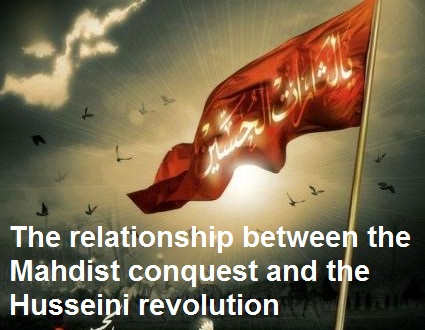
This phrase clarifies the direct relationship between the revolution of Imam al‑Mahdi (may Allah hasten his reappearance) and the revolution of Imam Husayn (peace be upon him). It refers to seeking justice for the blood of Imam Husayn, his sons, the descendants of the Messenger of Allah, and even the thirsty infant who was slain by the enemies, as well as the blood of the companions of Husayn.
This is not a matter of personal revenge. It is the cause of an entire nation and a struggle against an unjust system of rule under which the Muslim community has lived for more than fourteen centuries.
That system produced the evil figures who appeared in Karbala—such as Yazid, Ibn Ziyad, Shimr, and Umar ibn Sa‘d.
At the same time, the noble models that appeared in Karbala—the oppressed and righteous—have inspired generations throughout Islamic history.
Thus the well‑known saying emerged:
“Every day is Ashura, and every land is Karbala.”
Karbala represents the ongoing struggle between truth and falsehood throughout human history. At the heart of this struggle lies the question of divine leadership. Its roots go back to the conflict between Adam—the divine vicegerent—and Iblis, who refused the divine command to bow to Adam. Since that time there have been heirs of Adam who carry the divine trust, and heirs of Iblis who dispute that leadership and place it in the hands of those unworthy of it.
The distancing of the Muslim community from the divinely appointed leadership of the Imams from the Ahl al‑Bayt allowed unworthy individuals to seek power. Leadership turned into hereditary monarchy, rulers fragmented the Muslim world, enemies became dominant over it, and many Muslim lands fell under foreign influence.
### A Question
Some extremist groups claim that Imam al‑Mahdi (peace be upon him) will come to take revenge against Sunnis because of the slogan “O avengers of Husayn.”
This is a misconception spread by enemies. The struggle led by Imam al‑Mahdi will not be between sects, but between:
Truth and falsehood
Justice and oppression
The oppressed and the arrogant
His struggle will be against all who oppose the divine project of establishing justice on earth.
Groups such as ISIS and similar movements claim to represent Sunni Islam, yet their reality has become clear. Many of their victims have in fact been Sunni Muslims themselves, deceived by their false claims. Wherever they appear, they bring destruction and bloodshed.
### The Mission of Imam al‑Mahdi
Imam al‑Mahdi (peace be upon him) is the final Imam among the twelve infallible leaders from the Ahl al‑Bayt. He will emerge from the unseen state of occultation to establish the divine government of justice on earth. His mission will complete the path of humanity and unveil knowledge that will allow people to live in prosperity through both faith and understanding.
### Conclusion
We conclude with the first proclamation attributed to Imam al‑Mahdi at the time of his blessed appearance, as narrated from Imam Muhammad al‑Baqir (peace be upon him):
“The Qa’im will stand in Mecca, leaning his back against the Sacred House and seeking refuge in it. He will call out:
‘O people, we seek the help of Allah. Who among the people will respond to us? We are the family of your Prophet Muhammad, and we are the closest people to Allah and to Muhammad.
Whoever argues with me concerning Adam—I am the most entitled to Adam.
Whoever argues with me concerning Noah—I am the most entitled to Noah.
Whoever argues with me concerning Abraham—I am the most entitled to Abraham.
Whoever argues with me concerning Muhammad—I am the most entitled to Muhammad.
Whoever argues with me concerning the prophets—I am the most entitled to the prophets.
Does not Allah say in His Book:
“Indeed Allah chose Adam, Noah, the family of Abraham, and the family of Imran above all people—descendants, one from another. And Allah is All‑Hearing, All‑Knowing.”
I am the remnant of Adam, the treasure of Noah, the chosen one from the line of Abraham, and the select descendant of Muhammad.
Whoever argues with me concerning the Book of Allah—I am the most entitled to the Book of Allah.
Whoever argues with me concerning the Sunnah of the Messenger of Allah—I am the most entitled to the Sunnah of the Messenger of Allah.
I ask in the name of Allah that whoever hears my words today convey them to those who are absent. I ask you by the right of Allah, the right of His Messenger, and my right as a relative of the Messenger of Allah: help us and protect us from those who oppress us.
For we have been frightened, oppressed, driven from our homes and children, denied our rights, and falsely accused by the people of falsehood.
So fear Allah concerning us. Do not abandon us. Support us, and Allah will support you.’”
…
Peace be upon Husayn,
And upon Ali ibn Husayn,
And upon the sons of Husayn,
And upon the companions of Husayn.