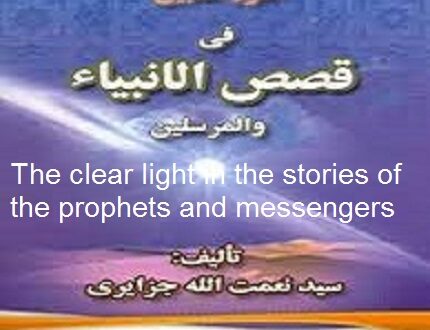
The clear light in the stories of the prophets and messengers 1
10 hours ago
-Culture الثقافة
2 Views
The trustworthy **ʿAlī ibn Ibrāhīm** narrated in an authentic report from **Abū ʿAbd Allāh** (peace be upon him):
> **“God has not sent any prophet from the time of Adam onward except that he will return to this world and support the Commander of the Faithful (ʿAlī) (peace be upon him). This is the meaning of His saying,
> ‘And you shall surely believe in him’—that is, in the Messenger of God, may God bless him and his family—‘and you shall surely support the Commander of the Faithful (peace be upon him).’
> Then He said to them in the world of ذرّ (pre-existent progeny): ‘Do you acknowledge, and accept My covenant upon that?’—that is, My pact. They said: ‘We do acknowledge it.’ God said: ‘Then bear witness, and I am with you among the witnesses.’”**
**I say:** Reports have come in abundance that when **al-Qāʾim** (peace be upon him) rises and the dominion is established for him, in his time the Prophet (peace and blessings be upon him and his family) and the Commander of the Faithful (peace be upon him) will emerge. He will bear the **staff** and the **branding mark**, and by God’s name a mark will be imprinted upon the forehead saying: **“This is a believer,”** and upon the forehead of the unbeliever will be imprinted: **“This is an unbeliever.”**
The Imams—may God’s blessings be upon them—and the prophets—may God’s blessings be upon them—will come forth to support the Commander of the Faithful (peace be upon him) and the Mahdī, may God’s blessings be upon him, especially those prophets who were harmed for the sake of God, such as **Zechariah, John, and Ezekiel**, and those among them who were killed or wounded. For the reports have abundantly stated that they will return to this world in order to take retribution from the communities that harmed and killed them, and in order to avenge al-Ḥusayn (peace be upon him).
And from **Jamīl**, from **Abū ʿAbd Allāh** (peace be upon him), he said:
I said regarding the saying of God Almighty:
> **“Indeed, We shall surely support Our messengers and those who believe in the life of this world and on the Day when the witnesses arise.”**
He said:
> **“By God, that is in the الرجعة (Return). Do you not know that many of God’s prophets were not supported in this world, and the Imams after them were killed and were not supported in this world? That support, then, is in the Return. And ‘the witnesses’ are the Imams (peace be upon them).”**
**The author of the book says—may God support him:**
What is meant by **“the messengers”** in the verse is the **prophets**. Thus, in this hadith, the one before it, and others narrated with the same meaning, there is evidence that **all the prophets** (peace be upon them) will return to this world in the **minor resurrection**, and God Most High will support them with power and with the angels against their enemies and the enemies of the family of Muḥammad (peace be upon them).
God, Glorified is He, will also revive the nations that harmed them, just as He will bring forth the **Banū Umayyah** and those among their descendants and others who approved of their deeds. Likewise, He will revive those from among the nations who were sincere in faith, so that they may attain the reward of supporting and striving, and may enjoy the blessings under the rule of the family of Muḥammad, peace be upon them, just as He, exalted is He, says:
> **“And on the Day We shall raise from every nation a group.”**
And **al-Ṣadūq**—may God perfume his resting place—said:
> **“Our belief concerning the number of the prophets (peace be upon them) is that they were one hundred thousand and twenty-four thousand prophets, and one hundred thousand and twenty-four thousand legatees; and that the chiefs of the prophets are five, around whom the millstone revolved. They are the possessors of the sacred laws, and those who brought an independent law that abrogated the law of those before them. They are five: Noah, Abraham, Moses, Jesus, and Muḥammad. They are the possessors of firm resolve (*Ulū al-ʿAzm*), peace be upon them.”**
**I say:** What he said regarding their number—peace be upon them—is what the clear reports indicate, and what our scholars, may God be pleased with them, have affirmed. Whatever indicates otherwise is to be interpreted figuratively, such as the narration:
> **“I was sent after eight thousand prophets, four thousand of whom were from the Children of Israel,”**
meaning by that the **greatest** of the prophets (peace be upon them).
As for the **messengers**, it is reported from him (peace and blessings be upon him and his family) that they were **three hundred and thirteen**.
And when he was asked:
> **“O Messenger of God, how many books did God send down?”**
He said:
> **“One hundred books and four books. God sent down fifty scrolls upon Seth, thirty scrolls upon Idrīs, and twenty scrolls upon Abraham; and He sent down the Torah, the Gospel, the Psalms, and the Furqān.”**
And in the book **al-Ikhtiṣāṣ** by **al-Mufīd**—may his resting place be sanctified—with his chain to **Ṣafwān al-Jammāl**, from **Abū ʿAbd Allāh** (peace be upon him), he said:
> **“He said to me: O Ṣafwān, do you know how many prophets God sent?”**
He said:
> I said: I do not know.
He said:
> **“God sent one hundred and forty thousand prophets, and the same number of legatees.”**
And from him (peace be upon him), **Abū Dharr** said:
> **“O Messenger of God, how many prophets did God send?”**
He replied:
> **“Three hundred and twenty thousand prophets. Among them, the messengers were three hundred and some more than ten, and the books sent down were one hundred and twenty-four books, among them fifty scrolls sent down upon Idrīs.”**
**I say:** The way to reconcile these two reports and what preceded them is either:
– by taking the additional number of prophets to refer to those who were **before Adam** (peace be upon him), since the earth is never devoid of a divine proof so long as moral responsibility remains;
– or by saying that the implication of a number is **not decisive proof**.
And from **Abū al-Ḥasan Mūsā** (peace be upon him), who said:
> **“The prophets and the followers of the prophets were distinguished by three qualities: sickness in their bodies, fear of the ruler, and poverty.”**
**I say:** It may be that by **the prophets** here are meant the infallible ones among them, those purified from sins. It may also be meant in a broader sense, in which case the descendants of the Messenger of God (peace and blessings be upon him and his family) from among the **ʿAlawīs** would all be included in these three conditions.
As for **the followers**, they are the scholars, the righteous, the poor, and the God-fearing.
And in the book **al-Iqbāl** by **Ibn Ṭāwūs**—may God sanctify his soul—with his chain to **al-Thumālī**, he said…
—
If you want, I can next give you either:
– a **more polished fluent translation**,
– a **strictly literal translation** preserving the original structure,
– or a **theological notes version** explaining terms like **rajʿa**, **Qāʾim**, **Ulū al-ʿAzm**, and the number traditions.
 WILAYAH NEWS VOICE OF THE GLOBAL AWAKENING