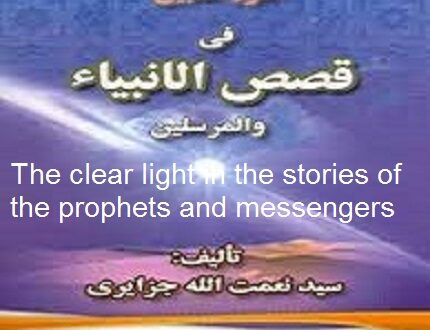
The clear light in the stories of the prophets and messengers 5
2 minutes ago
-Culture الثقافة
0 Views
…Ishmael son of Abraham lived one hundred and twenty years, Isaac lived one hundred and eighty years, Jacob (peace be upon him) lived one hundred and twenty years, Joseph (peace be upon him) lived one hundred and twenty years, Moses (peace be upon him) lived one hundred and twenty-six years, Aaron (peace be upon him) lived one hundred and thirty-three years, and David (peace be upon him) lived one hundred years, forty of which were his reign. Solomon son of David (peace be upon him) lived seven hundred and twelve years.
And from him (peace be upon him), he said:
> “A prophet from among the prophets might be afflicted with hunger until he dies of hunger. A prophet from among the prophets might be afflicted with thirst until he dies of thirst. A prophet from among the prophets might be afflicted with ailments and diseases until they consume him. A prophet might come to his people, stand among them, command them to obey Allah, and call them to the Oneness of Allah—while he does not even have a night’s provisions—and they do not let him finish his speech nor listen to him until they kill him. Verily, Allah, Blessed and Exalted is He, tests His servants according to their status in His sight.”
And from Abū al-Ḥasan (peace be upon him):
> “Among the characteristics of the prophets are cleanliness, perfuming oneself, shaving hair, and frequent marital relations.”
And from the Commander of the Faithful (peace be upon him):
> “Supper after the onset of night darkness (*al-‘Atama*) is the supper of the prophets.”
And from Abū al-Ḥasan al-Riḍā (peace be upon him):
> “There is no prophet who has not been invited to eat barley and blessed it. It never enters a stomach without expelling every disease within it. It is the sustenance of the prophets and the food of the righteous; Allah—Exalted is He—refused to make the sustenance of His prophets anything but barley.”
And from al-Ṣādiq (peace be upon him):
> “*Sawīq* (parched barley gruel) is the food of the messengers, and meat with milk is the broth of the prophets. The most beloved condiments [food accompaniments] to the Messenger of Allah (peace and blessings be upon him and his family) were vinegar and olive oil, and it is the food of the prophets. A household that uses vinegar and oil as a side dish will never be poor.”
**And al-Ṣadūq**—may his resting place be sanctified—narrated in his book *‘Ilal al-Sharā’i‘* with his chain to **Ibn al-Sikkīt**, who said:
I asked Abū al-Ḥasan al-Riḍā (peace be upon him): “Why did Allah send Moses son of ‘Imrān with the White Hand, the Staff, and the tools of magic; and send Jesus with medicine; and send Muhammad with speech and oratory?”
He (peace be upon him) replied:
> “Verily, when Allah, Blessed and Exalted is He, sent Moses, magic was the prevailing characteristic of the people of his time. So he brought them from Allah, the Mighty and Exalted, that which was beyond their capacity to replicate, and with which he nullified their magic, thereby establishing the proof against them.
> And when Allah, Blessed and Exalted is He, sent Jesus, it was at a time when chronic illnesses had appeared and people were in need of medicine. So he brought them from Allah, the Mighty and Exalted, that which they did not possess the like of, and with which he revived the dead, healed the blind, and the leper by the permission of Allah, thereby establishing the proof against them.
> And when Allah, Blessed and Exalted is He, sent Muhammad (peace and blessings be upon him and his family), it was at a time when oratory and speech were the prevailing characteristics of the people of his era. So he brought them from the Book of Allah, the Mighty and Exalted, his exhortations, and his rulings, that which nullified their speech and established the proof against them.”
Ibn al-Sikkīt said: “By Allah, I have never seen the like of this day. So what is the proof against the people today?”
He (peace be upon him) replied:
> “The Intellect (*al-‘Aql*); by it one knows the one who is truthful regarding Allah and believes him, and the one who is a liar regarding Allah and denies him.”
Ibn al-Sikkīt said: “This, by Allah, is the answer.”
—
### Conclusion on the Infallibility of the Prophets and the Interpretation of That Which Suggests Otherwise
**Al-Ṣadūq**—may God sanctify his tomb—said:
“Our belief concerning the prophets, messengers, Imams, and angels—peace be upon them—is that they are infallible and purified from all impurity, and that they do not commit any sin, small or large. They do not disobey Allah in what He commands them, and they do what they are commanded. Whoever denies infallibility regarding them in any of their states has been ignorant of them.
Our belief concerning them is that they are described by perfection, completeness, and knowledge from the beginning of their affairs until the end of them; they are not described in any of their states as having deficiency or ignorance.”
He (may his memory be sanctified) narrated in the book *al-Amālī* with his chain to **Abū al-Ṣalt al-Harawī**, who said:
“When al-Ma’mūn gathered for ‘Alī ibn Mūsā al-Riḍā (peace be upon him) the followers of various doctrines from among the Muslims, the different religions, the Jews, the Christians, the Magians, the Sabaeans, and the rest of the sects, and he did not…”
—
I can continue with the next part of this debate or provide a glossary for the key theological terms used in these passages (such as *‘Ismah*, *‘Aql*, or the various food-related traditions) if you would find that helpful.
 WILAYAH NEWS VOICE OF THE GLOBAL AWAKENING