WILAYAH NEWS VOICE OF THE GLOBAL AWAKENING


Related Articles


### Divine Intervention to Correct Social Deviation
When we examine the verses of the Noble Qur’an, we find references to the intervention of the unseen hand preventing the movement of social deviation from dominating human reality, and to divine intervention in many instances to correct the course of human society.
Among the events mentioned by the Qur’an regarding the correction of social paths are the stories of the **people of Noah, the people of Lot, the people of Hūd, and the people of Ṣāliḥ**—nations whom Allah destroyed because they had become a cause of absolute corruption and showed no readiness for reform. This contrasts with the **people of Jonah**, whom Allah forgave after they sincerely repented to Him.
The Qur’an also tells us about the **splitting of the sea for the people of Moses (peace be upon him)** to save them and drown **Pharaoh and his army**. Divine punishment did not encompass all the Egyptians; rather, it was limited to the ruling authority, its military forces, and those who followed them when he called upon his people to exterminate the Children of Israel. This represents **direct divine intervention** in addressing deviations.
As for **indirect intervention**, Allah—Blessed and Exalted—has clarified that through His will and sovereignty He moves human society in a way that restricts the movement of deviation, even if that society does not completely eliminate it. Allah says:
> “And these days We alternate among the people so that Allah may make evident those who believe and take from among you martyrs. And Allah does not love the wrongdoers.”
And He says:
> “Those who were expelled from their homes without right, except that they said: ‘Our Lord is Allah.’ Had Allah not repelled some people by means of others, monasteries, churches, synagogues, and mosques in which the name of Allah is much mentioned would surely have been destroyed. And Allah will surely support those who support Him. Indeed, Allah is Strong and Mighty.”
And He says:
> “If the people of the towns had believed and been mindful of Allah, We would have opened for them blessings from the heaven and the earth; but they denied, so We seized them for what they used to earn.”
And He says:
> “Indeed, they are devising a plan, and I too am devising a plan. So give the disbelievers respite; let them be for a while.”
And He says:
> “They planned, and Allah planned; and Allah is the best of planners.”
This concerns the **level of social movement**.
—
### Social and Political Studies
**In the Realm of the Husseini Epic (4)**
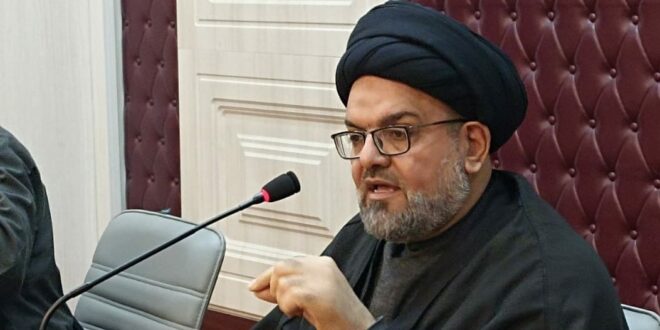
**Abd al‑Sattar al‑Jabiri**
—
## The Unseen and the Future of the Individual
Regarding the **individual level**, one of the clearest proofs of the role of divine decree in shaping a person’s material future is found in **Sūrat Yūsuf (Joseph)**. It describes what Allah destined for the future of Joseph (peace be upon him) when He showed him in a dream **eleven stars, the sun, and the moon prostrating to him**. When he told his father about the dream, **Jacob (peace be upon him)** informed him of the great future awaiting him and that this future would complete the path of **the Prophet Abraham and Isaac (peace be upon them)** and would be a step toward completing Allah’s favor upon the family of Jacob.
Looking generally at the story of Joseph (peace be upon him), we find that the chapter highlights **three important matters**:
Every human being is created to **be tested and to test others**, and through him Allah accomplishes something He intends. Joseph was a test for his brothers, and they failed that test. He was a test for the **wife of al‑ʿAzīz**, and she failed. He was a test for the **Azīz of Egypt**, who failed when he unjustly imprisoned him. Joseph was also a test for the **two fellow prisoners**, the **people of Egypt**, the **human community**, and the **idol worshippers**.
At the same time, Joseph himself was tested through them. He forgave his brothers, forgave the wife of al‑ʿAzīz and the women of the city, saved humanity from destruction through famine, and called people to the worship of Allah with wisdom and good counsel.
Among what Allah accomplished through Joseph (peace be upon him) were:
– the spread of **monotheism in Egypt**,
– the migration of **the family of Jacob from the Syrian desert to Egypt**, where they learned civilization and administration,
– preparing them to become the nucleus of a **monotheistic state under Joshua ibn Nun (peace be upon him)** after the wandering period and the deaths of **Moses and Aaron (peace be upon them)**.
This meaning also appears in the story of **the wife of al‑ʿAzīz**, through whom Allah manifested a miracle of Joseph demonstrating the truthfulness of his prophethood after she was restored to youth after old age. Likewise, the **cupbearer of the king**, who informed the king that he knew someone capable of interpreting his dream, became the means for Joseph’s release from prison and his role in saving human society from famine. His closeness to the king of Egypt also had an important role in the future of the call to monotheism and the rejection of idol worship.
—
## Examples Among Non‑Prophets
When applying this principle to people other than prophets and those who lived alongside them, we find clear examples throughout human history among both **righteous individuals and corrupt ones**.
### Among the Righteous
For example, after **Marxist ideology dominated the eastern world** from Eastern Europe to China and other countries that followed them, and **capitalist ideology dominated from America to Japan and their allied states**, denial of religious values spread in both camps and religion was considered incapable of leading society.
In the midst of this struggle—and after many setbacks suffered by religious people under ruling authorities—**Sayyid Ruhollah al‑Musawi al‑Khomeini** emerged as a jurist and scholar who confronted tyranny in his country. Society moved with his movement and responded to his call despite his exile. His movement overthrew the **monarchical system in Iran**, declaring the country an **Islamic Republic governed according to the principles of the Qur’an and the purified Sunnah**, under the slogan “Neither East nor West.”
This changed the global perception of religion and its ability to lead society. After his death, the Islamic Republic continued its path despite many obstacles, confronting major powers and their regional allies and altering many regional political and security equations. This was made possible by the country’s human resources, economic wealth, strategic location, and firm belief in the principles of the revolution.
All of this contributed to the growth of **Islamic resistance**, increased opposition to global domination, and imposed new realities in the region—shaped by the blood of martyrs and the spirit of sacrifice—after many had previously submitted to the will of the East, the West, and the occupying Zionist entity.
Thus, **Imam Khomeini** became a test for the Iranian people, the Iranian authorities, regional governments, various religious and sectarian trends, and for the East and the West—and they were also a test for him. Reality proved the validity of his path and the failure of those who opposed him. Through him, Allah weakened the movement hostile to religion and to Islamic governance, revived hope among Muslims and the oppressed of the world, and demonstrated that they could achieve self‑determination and defeat their enemies. The method associated with **the Ahl al‑Bayt (peace be upon them)** returned to prominence after attempts had been made to erase it.
—
### Among the Corrupt
As an example among corrupt figures, one may consider **Saddam Hussein al‑Majid**, the former ruler of Iraq. When examining his early personal and family background, it would not appear possible that someone like him could reach the rule of Iraq. However, a series of circumstances formed the objective conditions that enabled him to reach power.
These included:
– the fall of the monarchy in Iraq,
– struggles for power among Qasim, nationalist, Ba‘athist, and communist factions,
– regional interference in Iraq by Gamal Abdel Nasser, Gulf states, and Jordan,
– the internal war with Kurdish separatists,
– major social transformations after the fall of the monarchy,
– attempts to militarize society and weaken the private sector,
– administrative weakness during the rule of Abd al‑Rahman Arif,
– the decline of the communist movement in Iraq,
– the Ba‘ath Party’s rise to power in 1968,
– Saddam’s appointment as Minister of Interior and later Vice President.
Later, after the **Islamic Revolution in Iran**, Western powers sought to overthrow the new Islamic system and encouraged Gulf states to support that effort. All these conditions enabled the village youth to reach the seat of power, becoming a test for the Iraqi people, the Iranian people, and the peoples of the region.
He plunged Iraq into an **eight‑year war with Iran**, a conflict that brought immense suffering without benefiting Iraq or its people. Later he **invaded Kuwait** after it refused to provide the funds he demanded. His actions caused the death and disability of millions of Iraqis and Iranians, and later Kuwaitis, and damaged the economies of Iran, Iraq, Kuwait, and several Gulf states. His policies also harmed the Syrian and Lebanese peoples and others in the region.
This was part of the ordeal through which people were tested by Saddam and through which he himself was tested. His tyrannical authority and bloody policies spared neither child nor elder, neither woman nor youth, neither civilian nor religious scholar. The consequences of his crimes continue to affect the region—especially the Iraqi people—to this day.
Yet what Allah ultimately brought about through these circumstances included the migration of many participants in the **1991 Sha‘bani uprising** who fled Iraq and later formed political forces that played an important role in shaping Iraq’s political landscape after the fall of his regime in **2003**.
After his fall, **Shi‘a and Kurds**, who had long been marginalized under earlier governments since 1921, gained a significant role in governing the Iraqi state. Iraqi Shi‘a political forces became active in supporting the political process and defending Iraq when it faced sectarian terrorism from extremist groups such as **ISIS**, supported by regional sectarian agendas and international intelligence networks.
Iraq thus became an active player in regional politics, as reflected in its positions at various international conferences regarding regional security and the Palestinian issue. Shi‘a movements also played a role in resisting efforts aimed at drawing Syria into an American‑Zionist axis, and in supporting the Palestinian cause.
Additionally, the migration of Iraqi Shi‘a communities to different parts of the world—whether to the **Rafha refugee camp in Saudi Arabia**, or to **Iran**, **Syria**, and later to many other countries—helped spread the teachings of **Ahl al‑Bayt** and Shi‘a religious rituals globally. Commemorations of **Imam Husayn**, especially on the **10th of Muharram** and the **20th of Safar (Arbaʿeen)**, are now observed around the world—from Australia in the east to the United States and Canada in the west. Some commemorations even take place near the **White House** in Washington.
Such developments were historically unprecedented. Among the outcomes that unfolded—despite Saddam and those behind him—was Iraq’s transformation into an important supporter of the **axis of resistance**, with many Shi‘a groups openly joining it and influencing regional events and political equations.