WILAYAH NEWS VOICE OF THE GLOBAL AWAKENING


Related Articles



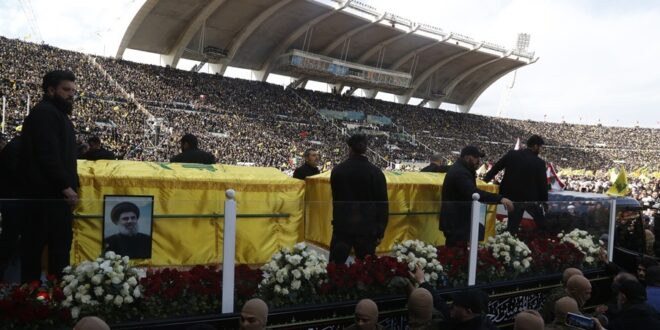
The Grand Funeral Scene, Exactly One Year Later
Layla Amasha
Today, hearts gather around the memory, just as they did one year ago, when they gathered around the two majestic coffins, waving a final farewell with tears. On this day, time witnessed a moment that held the gentlest scenes of reunion and the deepest sighs of farewell simultaneously. A moment when Sayyid Hassan embraced in the shadow of his coffin all his sons and daughters, all his brothers and sisters, and all his family—just as they lived in the shadow of his turban throughout his life. On this day, the coffin of the noble Hashemi, alongside that of his lifelong companion, comrade in arms, and beloved soul, journeyed together. Shoulder to shoulder, they reached their final resting place, where the time for eternal rest in the warmth of the earth had arrived, and where they would now find the well-deserved rest.
Each member of the resistance has a different story about February 23, 2025. All these stories document a day that will never be forgotten. On that day, it seemed as if hearts had torn through their ribs and were thrown upon the two majestic coffins, never to return. It seemed as though two bright suns were parting the crowds of mourners, gently wiping the faces of weeping mourners and red-eyed onlookers, walking in serenity and peace toward the final resting place, where reunion would one day be possible, and where souls would find a place to visit whenever hurt or sorrow touched them.
From the night of February 22-23, 2025, crowds began gathering inside and around the Sports City, along the path the funeral procession would take. From all corners of the earth, loved ones arrived—to meet the Sayyid, to bid him farewell.
The elderly were the first to arrive, and in their faces, one could see the image of parents bidding farewell to their firstborn. Here, an eighty-year-old woman weeps profusely for her beloved, addressing him with a voice cracked by loss: “Is this how you’re leaving us, Sayyid?” Then comes a voice with a Bekaa accent, a back bent under the weight of more than ninety years, “God be with you, O Sayyid of men… God be with you, O light of our eyes.”
For the men and women whose ages were similar to the Sayyid’s, their faces reflected the sorrow of brothers and sisters who had lost their leader and pillar. No grief resembled theirs, as they choked on broken thoughts. The men among them tried to maintain the firmness the Sayyid had shown during the funerals of Hajji Imad and Hajji Qassem. As for the sisters, they had held back their tears for many days since receiving the news, but they were freed in the hour of the encounter, speaking with the depth of their unspeakable grief, with a wound that would never heal, and with tales of patience.
The youth, the so-called orphans of the Sayyid, stood as all the sons of martyrs do, raising their fists in a vow to continue the path, to seek revenge. With their other hands, they held their hearts in place, so they would not escape, accompanying the precious body to the soil.
Then came the children, who instinctively recognized the magnitude of the loss and the shape of the orphanhood that had descended upon their lives, crying as if each of them had just lost their parents. They held his picture as if it were their identity, or a map of their homeland. From the tone of their voices, it was clear that they had absorbed fragments of the Sayyid’s light within their souls, carrying his trust with responsibility and love, and you realize you are in the presence of a great heavenly secret.
All the signs of composure vanished the moment the two coffins emerged to the sound of Sayyid Hassan’s voice: “O beloved ones, O honorable ones, O noblest of people.” Cries of anguish pierced the air, and the crowd turned into a flood of free-flowing tears. In those moments, when grief seemed overwhelming, sorrow seemed unbearable, and pain surpassed all limits of endurance, enemy warplanes appeared overhead. In an instant, all the grief turned into strength, the sorrow into a revolution, and the pain into resolve: “Here I am, O Nasrallah,” the crowd shouted. Fists were raised, and the sound of resistance from the wounded voices was louder than the roar of the planes. Everyone in the crowd declared, “Death is sweet.” All hearts recalled what they had learned from the Sayyid, from the blood of the Sayyid, and stood to deliver a message to the enemy: We are the people of the victory of blood over the sword, we are not frightened by loss, nor by missiles. We are the children of “He is no humiliation for us,” our school is Karbala, and in it, we have learned that we have seen nothing but beauty.
The two coffins slowly moved forward, covered in flowers. The crowd stopped them from time to time, pausing for a moment among the mourning hearts. When Sayyid Hassan reached his final resting place, the moment took on a deep personal significance. Here, each of us would have a chance to meet the Sayyid, to speak our hearts near his shrine, to whisper what the souls that have lost him have kept hidden, to visit him—even if between the visitor and him stood the marble inscribed with the name of the righteous servant: Sayyid Hassan Abdul Karim Nasrallah.
A year has passed since that day, and its impact was so powerful that it seemed to stretch toward eternity. Yet, every time it is remembered, each of us drifts away in a reverie, and our souls recall every detail of the funeral—the scent of the air, the warmth of the sun on the faces, the loudspeakers, and the tears of the mourners.