WILAYAH NEWS VOICE OF THE GLOBAL AWAKENING


Related Articles

When Trump Uses the Assassination of General Soleimani to Justify Escalation Against Iran
By Omar Ma’araboni
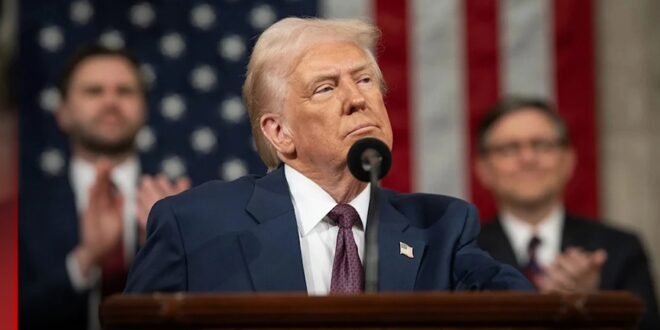
U.S. President Donald Trump delivered his “State of the Union” speech at the Capitol building, marking the second speech of his second term.
The speech included sharp and dual messages towards Iran, blending direct military threats with an opening for negotiations, in what was described as “the longest in the history of State of the Union speeches.”
Trump used symbolic language when he said that he had not yet heard “the secret word” from Tehran to reach an agreement, which was: “We will never possess nuclear weapons.”
Trump wants a public and final commitment from Iran to abandon its nuclear ambitions as a precondition for any breakthrough.
He confirmed that negotiations were ongoing, noting that the Iranians “want to make a deal,” but he would not accept anything less than full guarantees.
On this issue, Trump ignores the publicly declared fatwa (religious decree) that prohibits the production of nuclear weapons and insists on lying and ambiguity to maintain justification for any military adventure he might undertake.
Trump tried to reconcile his previous claims of destroying the Iranian nuclear program through “Midnight Hammer” in June 2025 with his current need to threaten them.
He claimed that U.S. forces “eradicated” the nuclear program last year, but accused Iran of trying to “start over from scratch.”
He considered that these new attempts provide the U.S. with a justification for military action again if diplomacy fails.
Trump raised the stakes of the warning to include U.S. national security directly:
He said that Iran was developing missiles that not only threaten U.S. bases in the region and Europe but will soon be “capable of reaching the United States.”
This escalation aims to rally domestic public opinion behind any potential military decision, considering that the threat is no longer just regional.
Despite the aggressive tone, Trump repeated the phrase: “I prefer to solve this problem through diplomacy.”
This statement comes at a time when Washington has deployed aircraft carriers and strategic bombers in the region.
Trump’s reminder of the killing of General Qassem Soleimani in the 2026 State of the Union speech was not just a reference to a historical event, but a political and military message directed at several parties at a very sensitive moment.
Trump wanted to send a direct message to the current Iranian leadership that the rules of engagement for him go beyond striking facilities to targeting leadership figures.
He was signaling that any Iranian escalation in response to the pressures of his second term might face personal repercussions targeting the top political and military leaders, not just Iran’s allies.
By mentioning Soleimani, Trump attempted to cement his ability to use force by affirming:
That he alone did what others dared not do, and that he was the one who carried out the “Midnight Hammer” operation (in June 2025) that targeted the nuclear program.
He also sought to assert that he is capable of threatening new military action.
The goal here is to show that he is a man of action, not words, and that he does not hesitate to make major and surprising decisions if he feels national security is threatened.
Since the speech was delivered before Congress, Trump used Soleimani’s mention to enhance his image as a strong leader, intending to embarrass his political opponents by reminding them that he took a step “that others failed to take.”
He described Soleimani as “the world’s number one terrorist,” in order to legitimize any future military action against Iran and present it as part of the “war on terrorism” rather than just a political struggle.
The reminder of Soleimani came just one day before scheduled negotiations in Geneva:
The goal was to break the morale of the Iranian negotiating team by reminding them of America’s capabilities and actions, and that he believes in the principle of “negotiating from a position of absolute power.” The mention of Soleimani serves as a reminder of the price Tehran might pay if diplomacy fails.
Trump adopted a “brinkmanship” strategy; he is preparing for the Geneva negotiations on Thursday with unprecedented escalatory rhetoric, placing Tehran between the “comprehensive agreement” or “direct targeting.”
The Three Major Messages:
-
Nuclear Bargaining: No lifting of sanctions or military de-escalation without Iran’s public acknowledgment of the phrase: “We will never possess nuclear weapons.”
-
Legitimizing Power: By mentioning “Midnight Hammer” (2025) and General Qassem Soleimani, Trump emphasizes that his resort to force is a “tangible, concrete action,” not just a verbal threat, and that he is ready to repeat it against individuals and facilities.
-
Expanding the Circle of Threat: Trump has constructed a new narrative considering Iranian missiles as a direct threat to U.S. territory, not just regional bases, to rally American public support for any potential confrontation.
Conclusion:
Militarily: Washington is amassing its strike power in the region as an extreme pressure tool.
Diplomatically: Trump is subtly opening the door for Geneva negotiations, considering them the last opportunity before “major actions.”