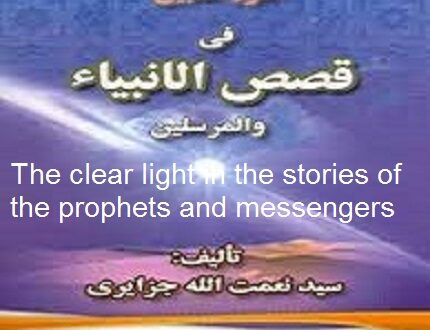
The clear light in the stories of the prophets and messengers 3
15 hours ago
-Culture الثقافة
0 Views
**The Luminous Light in the Stories of the Prophets and Messengers**
**3 / 8**
It is stated regarding the sustenance of the prophets:
**“O Allah, I ask You for abundant and wholesome provision from Your provision.”**
**I say:** What is meant by *lawful sustenance* in the two traditions is that which is truly lawful in reality and in the actual state of affairs, and this is the sustenance of the prophets and their legatees. As for the sustenance of the believers, it is lawful according to the outward ruling of the Sacred Law, though it may at times contain doubtful matters.
In **al-Kāfī**, from زرارة (Zurārah), he said: I asked Abū Ja‘far (peace be upon him) about the saying of Allah, **“and he was a messenger, a prophet”**—what is a messenger, and what is a prophet?
He said:
– **A prophet** is one who sees in his sleep, hears the voice, but does not behold the angel.
– **A messenger** is one who sees in sleep, hears the voice, and beholds the angel.
I said: What is the rank of the **Imam**?
He said:
– He hears the voice, but does not see nor behold the angel.
Then he recited this verse:
**“And We did not send before you any messenger, nor prophet, nor one spoken to…”**
And from al-Riḍā (peace be upon him):
– **A messenger** is one to whom Gabriel descends; he sees him and hears his words, and revelation comes down upon him. He may also sometimes see in his sleep, like the vision of Abraham (peace be upon him).
– **A prophet** may sometimes hear the speech, and may sometimes see the person, but not hear.
– **An Imam** is one who hears the speech but does not see the person.
And in an authentic report, from al-Aḥwal, he said: I heard Zurārah ask Abū Ja‘far (peace be upon him), saying: Inform me about the messenger, the prophet, and the one spoken to (*muḥaddath*).
He said:
– **The messenger** is the one to whom Gabriel comes openly; he sees him and Gabriel speaks to him.
– **The prophet** is one who sees in his sleep, in the manner that Abraham (peace be upon him) saw; and similarly, the Messenger of Allah (peace and blessings be upon him and his family) had signs of prophethood before revelation, until Gabriel came to him from Allah with the message.
– When Muhammad (peace and blessings be upon him and his family) was combined with prophethood and the message came to him from Allah, Gabriel (peace be upon him) came to him openly and spoke to him with it.
– Among the prophets are those for whom prophethood is combined, and who see in their sleep; the Spirit comes to them and speaks to them without their having seen him while awake.
– As for **the one spoken to** (*muḥaddath*), he is the one who is addressed, so he hears, but does not behold, nor does he see in sleep.
**I say:** The scholars of Islam differed regarding the distinction between a **prophet** and a **messenger**. Some said the two terms are synonymous. Others said there is a distinction: that a messenger is one who, in addition to the miracle, has a revealed scripture sent down to him; whereas a prophet who is not a messenger is one to whom no scripture is revealed, but rather he calls to a previous scripture.
—
**[9]**
Among them are those who said:
– Whoever possesses a miracle, a scripture, and abrogates the law before him is a **messenger**;
– Whoever does not possess all of these characteristics is a **prophet** but not a messenger.
Others said:
– The one to whom the angel comes visibly and commands him to call the people is a **messenger**;
– The one for whom this is not the case, but who sees in sleep, is a **prophet**.
Fakhr al-Rāzī and others mentioned these views. What appears from our traditions is the correctness of the last view, based on what has preceded concerning the number of the messengers and the fact that those whose law abrogated a previous law were only five.
And in the book **al-Baṣā’ir**, from the two Bāqirs (peace be upon them):
The messengers are of **four categories**:
1. **A prophet who is given prophethood within himself**, and it does not go beyond himself.
2. **A prophet who sees in sleep, hears the voice, but does not behold in wakefulness**, and has not been sent to anyone; over him is an Imam, just as Abraham was over Lot.
3. **A prophet who sees in sleep, hears the voice, and beholds the angel**, and has been sent to a group, whether few or many, as Allah said:
**“So We sent him to a hundred thousand or more.”**
And it is said that “or more” means thirty thousand more.
4. **A prophet who sees in sleep, hears the voice, and beholds in wakefulness, and he is an Imam**, like the possessors of firm resolve (*Ulū al-‘Azm*).
Abraham (peace be upon him) was a prophet, but he was not an Imam until Allah said:
**“Indeed, I will make you an Imam for the people.” He said, “And from my offspring?” He said, “My covenant does not reach the wrongdoers.”**
That is, one who worshipped an idol or an image.
**I say:** This means that the Imamate is a universal leadership over all creatures; therefore it is superior to prophethood and more noble than it.
In **al-Ikhtiṣāṣ** by al-Mufīd, from ‘Umar ibn Abān, from some of them, it is said:
– Five of the prophets were **Syriac-speaking**: Adam, Seth, Idrīs, Noah, and Abraham.
– Adam’s language had been **Arabic**, and it was the language of the people of Paradise. But when he disobeyed his Lord, it was changed for him into **Syriac**.
– Five were **Hebrews**: Isaac, Jacob, Moses, David, and Jesus.
– Five were **Arabs**: Hūd, Ṣāliḥ, Shu‘ayb, Ishmael, and Muhammad (peace and blessings be upon him and his family).
And two believers and two disbelievers ruled the world:
– The two believers were **Dhu al-Qarnayn** and **Solomon** (peace be upon him).
– The two disbelievers were **Nimrod son of Kūsh son of Canaan** and **Nebuchadnezzar**.
**I say:** *Naṣr*, with the pattern of *Buqam*, is the name of an idol, and *Bukht* means “was born,” because he was found cast aside near him, so it was as though he were his son.
And al-Ṣadūq—may his resting place be sanctified—narrated in **Ikmāl al-Dīn** a long tradition with his chain going back to…
—
If you want, I can also provide:
– a **more polished academic translation**,
– a **literal line-by-line translation**,
– or a **Shia theological summary** of this passage in English.
 WILAYAH NEWS VOICE OF THE GLOBAL AWAKENING