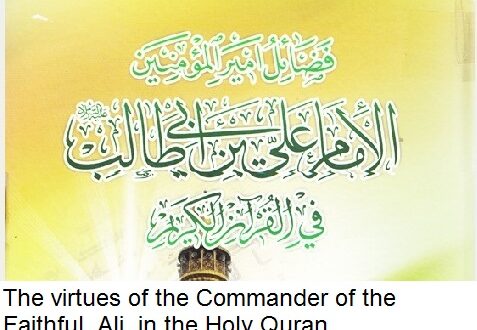
The virtues of the Commander of the Faithful, Ali, in the Holy Quran
45 seconds ago
-Culture الثقافة
0 Views
Here is the English translation of the provided text, authored by Abu Ma’ash, focusing on the exegesis of the verse “Guide us to the Straight Path.”
***
**Authored by: Abu Ma’ash**
**The First Verse**
The saying of the Almighty: **”Guide us to the Straight Path”** (1)
**(1)**
Ibn Shahrashub narrates from the *Tafsir* of Waki’ al-Jarrah, from Sufyan al-Thawri, from al-Suddi, from Asbat and Mujahid, from Ibn Abbas regarding the verse of the Almighty: “Guide us to the Straight Path,” he said: “Say: O servants of God, guide us to the love of Muhammad and his Ahl al-Bayt (the Prophet’s Household).” (2)
**(2)**
From Dawud bin Farqad, from Abu Abd Allah (Imam al-Sadiq, peace be upon him), who said: “Guide us to the Straight Path” means the Commander of the Faithful (Amir al-Mu’minin, peace be upon him). (3)
**(3)**
And from the *Tafsir* of al-Tha’labi, narrated by Ibn Shahin through his chain of narrators, from Muslim bin Hayyan, from Abu Buraydah, regarding the verse of the Almighty: “Guide us to the Straight Path,” he said: “The path of Muhammad and his Ahl al-Bayt.” (1)
**(4)**
Imam al-Askari (peace be upon him) said: Ja’far bin Muhammad al-Sadiq (peace be upon him) said: “Guide us to the Straight Path” means: Direct us to the Straight Path, for the sake of adhering to the road that leads to Your love, delivers us to Your Paradise, and prevents us from following our own whims so that we are overcome, or adopting our own opinions so that we perish. (2)
**(5)**
The Commander of the Faithful (peace be upon him) said: The Messenger of God (peace and blessings of God be upon him and his family) said, on the authority of Gabriel, from God the Almighty, that He said: “O My servants, all of you are astray except for whom I have guided; so ask Me for guidance, and I will guide you.” (3)
**(6)**
And from it [the same source]:
“O My servants, perform the best and greatest acts of obedience, so that I may forgive you even if you fall short in others. And abandon the greatest and ugliest of sins, so that I may not hold you accountable for committing others. For the greatest of acts of obedience is My Oneness (Tawhid), belief in My Prophet, and submission to the one whom he appointed after him—Ali bin Abi Talib—and the Pure Imams from his lineage.
And the greatest of sins in My sight is disbelief in Me and My Prophet, and opposing My vicegerent, Muhammad, and the one after him, Ali bin Abi Talib, and the leaders (Awliya) after him. If you wish to be with Me in the highest dwelling and the most noble honor, let no one among My servants be dearer to you than Muhammad, and after him his brother Ali, and after them, their sons who uphold the affairs of My servants after them. For whoever holds this belief, I will make him among the most noble kings of My Paradise.
And know that the most hateful of creation to Me is one who impersonates Me and claims My Lordship. And the most hateful of them to Me after him is one who impersonates Muhammad, disputes his prophethood, and claims it for himself. And the most hateful of them to Me after him is one who impersonates the legatee (Wasi) of Muhammad, disputes his position and honor, and claims them for himself. And the most hateful of creation to Me after these are those who claim what exposes them to My wrath, and those who assist them in that. And the most hateful of creation to Me after these are those who are content with their actions, even if they were not among their helpers.
Likewise, the most beloved of creation to Me are those who uphold My Truth. The best of them in My sight and the most honorable to Me is Muhammad, the Master of Mankind. The most honorable and best of them after him is Ali, the brother of the Chosen One (al-Mustafa), the Pleasing (al-Murtada). Then, after them, the upholders of justice: the Imams of Truth. The best of people after them are those who assist them in their Truth, and the most beloved of creation after them are those who love them and hate their enemies, even if they are unable to assist them.” (1)
***
**(Notes and Citations from the original text):**
(1) Al-Hamd: 6 (Surah Al-Fatiha, Verse 6).
(2) Tafsir al-Burhan: Vol. 1, 38/52.
(3) Tafsir al-Burhan: Vol. 1, 34/52.
(1) Tafsir al-Burhan: Vol. 1, 39/52.
(2) Sources: *Ta’wil al-Ayat*, Vol 1, 8/27; *Tafsir al-Imam*, 14. Also cited in *Bihar al-Anwar*, 47/238, via *al-Ihtijaj*; and *Bihar al-Anwar*, 92/228, H. 6, via *Uyun Akhbar al-Rida*, 1/238, H. 65; narrated by al-Saduq in *Ma’ani al-Akhbar*, 33; and Ibn Abi Firas in *Tanbih al-Khawatir*, 2/92.
(3) Sources: *Tafsir al-Imam*, 13, and from it *al-Mustadrak*, 1/360, H. 10; *al-Jawahir al-Sunniyah*, 171; *Ta’wil al-Ayat*, Vol 1, H. 9, p. 27.
(1) *Tafsir al-Burhan*.
 WILAYAH NEWS VOICE OF THE GLOBAL AWAKENING